Key takeaways
- Every unplanned hour is sold capacity you already spent — price it at $2,000-$5,000.
- A whiteboard and 30 days of honest tracking beats a CMMS your operators abandon by week six.
- Five repeat failures cause most of your lost hours. Kit the parts for all five.
You don't need a $40,000 CMMS to reduce unplanned downtime in manufacturing. You need honest numbers, a maintenance schedule that survives a busy week, and spare parts on the shelf for the five failures your lines repeat every quarter. Because an unplanned hour isn't a maintenance problem — it's sold capacity you already spent.
Unplanned Downtime Is Sold Capacity You Already Spent
Run the math on your own plant. A $6M co-packer scheduling 4,000 line-hours a year is booking roughly $1,500 of revenue against every scheduled hour. When the filler dies, that revenue doesn't pause. It leaves.
Then stack the rest of the cost of downtime in manufacturing terms. Eight people at a loaded $28 an hour standing near a dead line is another $224 an hour. Add the restart: purged product, rework, QA holds, the half-batch that drifted out of temp spec while you waited on a part. Most $2-15M food plants land between $2,000 and $5,000 per unplanned hour once they count everything. Fifty unplanned hours a quarter — a bad week and two average ones — is a six-figure leak every year.
This is the same arithmetic behind capacity utilization and what good looks like for a co-packer. Downtime is the hole in that bucket. You can't sell hours you keep losing.
OEE for Food Manufacturing: Measure It Honestly
OEE is availability times performance times quality. Simple formula, easy to cheat. Most plants cheat it three ways:
- Excluding changeovers from availability. If the line was scheduled and it wasn't running, it counts. Changeovers, CIP overruns, waiting on QA release — all of it.
- Using a speed you never run. Nameplate says 120 bottles a minute. You run thick sauce at 80. Measure performance against the speed you actually run.
- Ignoring rework. If product got recouped, re-run, or hand-sorted, it wasn't right the first time. It comes out of quality.
Measured honestly, a small high-changeover food plant usually lands at 40-60% OEE. The 85% "world class" number in every vendor deck comes from automotive lines running one part for a month. Ignore the benchmark. Watch your trend. An honest 48% that climbs to 55% in six months is real money. A flattering 72% that never moves is a bedtime story.
How to Reduce Unplanned Downtime in Manufacturing Without Buying Software
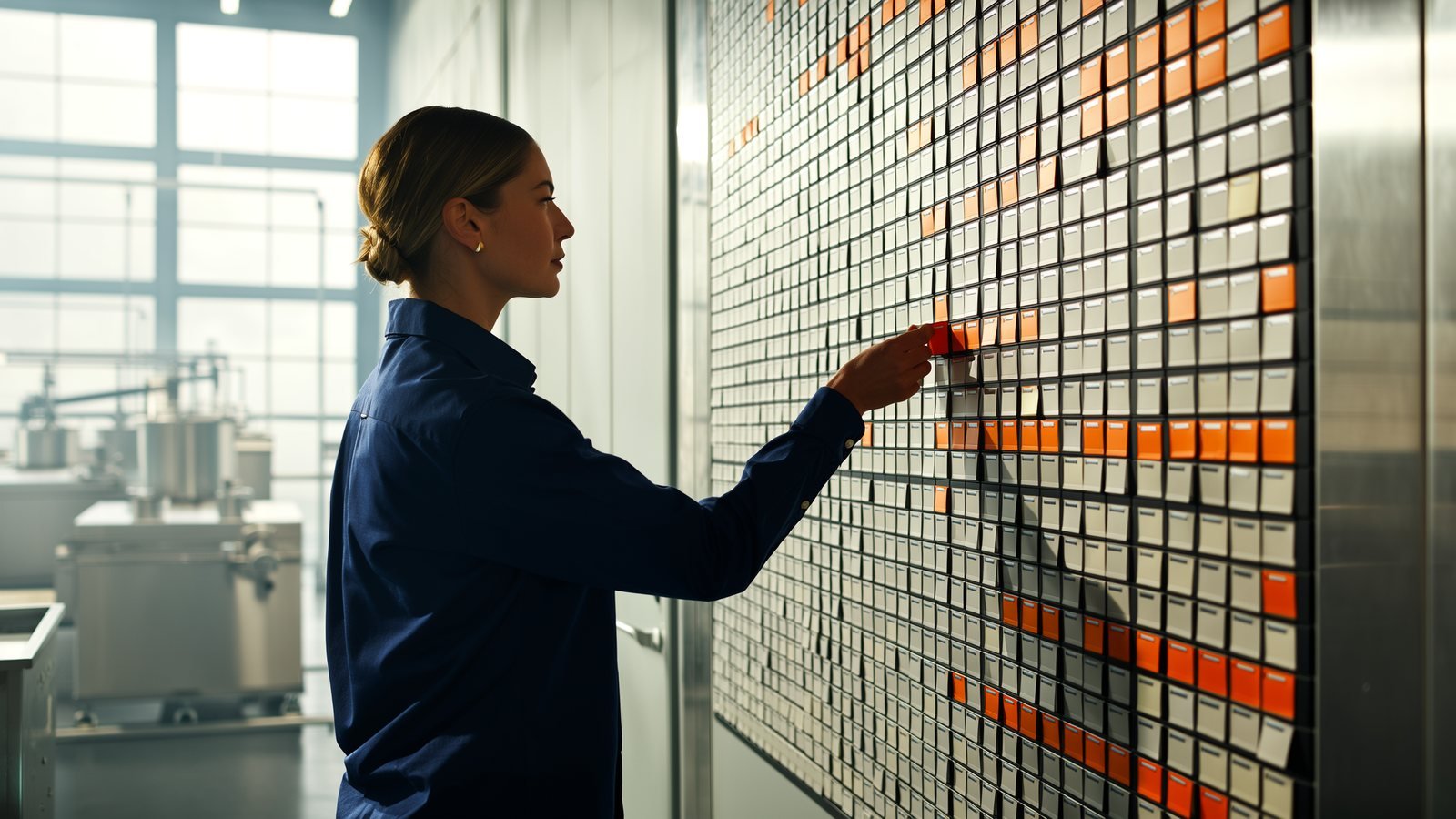
The CMMS vendors are right about one thing: you can't fix what you don't track. They're wrong that tracking requires their product. Downtime tracking on a whiteboard, done for 30 days, will tell you more than a software rollout your operators quietly abandon by week six.
- Hang a whiteboard or clipboard at each line.
- Every stop over five minutes gets a line: time, duration, reason in the operator's own words.
- Cap it at ten reason codes. "Filler jam," "no materials," "waiting on QA," "changeover ran long." If coding a stop takes a manual, operators stop coding.
- Every Friday, spend 30 minutes tallying hours by reason. That's your Pareto.
After 30 days you'll see what every plant sees: four or five causes account for 60-80% of lost hours. Now you have targets instead of vibes.
The Preventive Maintenance Schedule Nobody Follows
Every plant has a PM schedule. Almost nobody follows it, and the reason is always the same: when the week gets tight, PM looks optional and shipping doesn't. So PM slides a week, then a month, then the gearbox that needed $80 of oil needs $8,000 of teeth.
Preventive maintenance in a food plant survives only when it stops competing with production for the same hours:
- Bolt PM to sanitation windows. The line is already down for CIP or a wet wash. Greasing bearings and checking chain tension inside a wash window costs zero production hours.
- Make every task 30 minutes or less. "Rebuild the filler" gets postponed forever. "Check and torque head bolts, 20 minutes" gets done.
- Name one owner per line. Not "the maintenance team." One name, and a skipped PM shows up in Monday's meeting like a missed ship date — because that's what it becomes.
Yes, this gets harder when your schedule is chaos because brands won't tell you what's coming. That's a real problem with its own fix — scheduling production when brands won't forecast — but cutting PM to absorb schedule chaos just converts this month's crunch into next month's breakdown.
Spare-Parts Kits for the Five Failures That Repeat
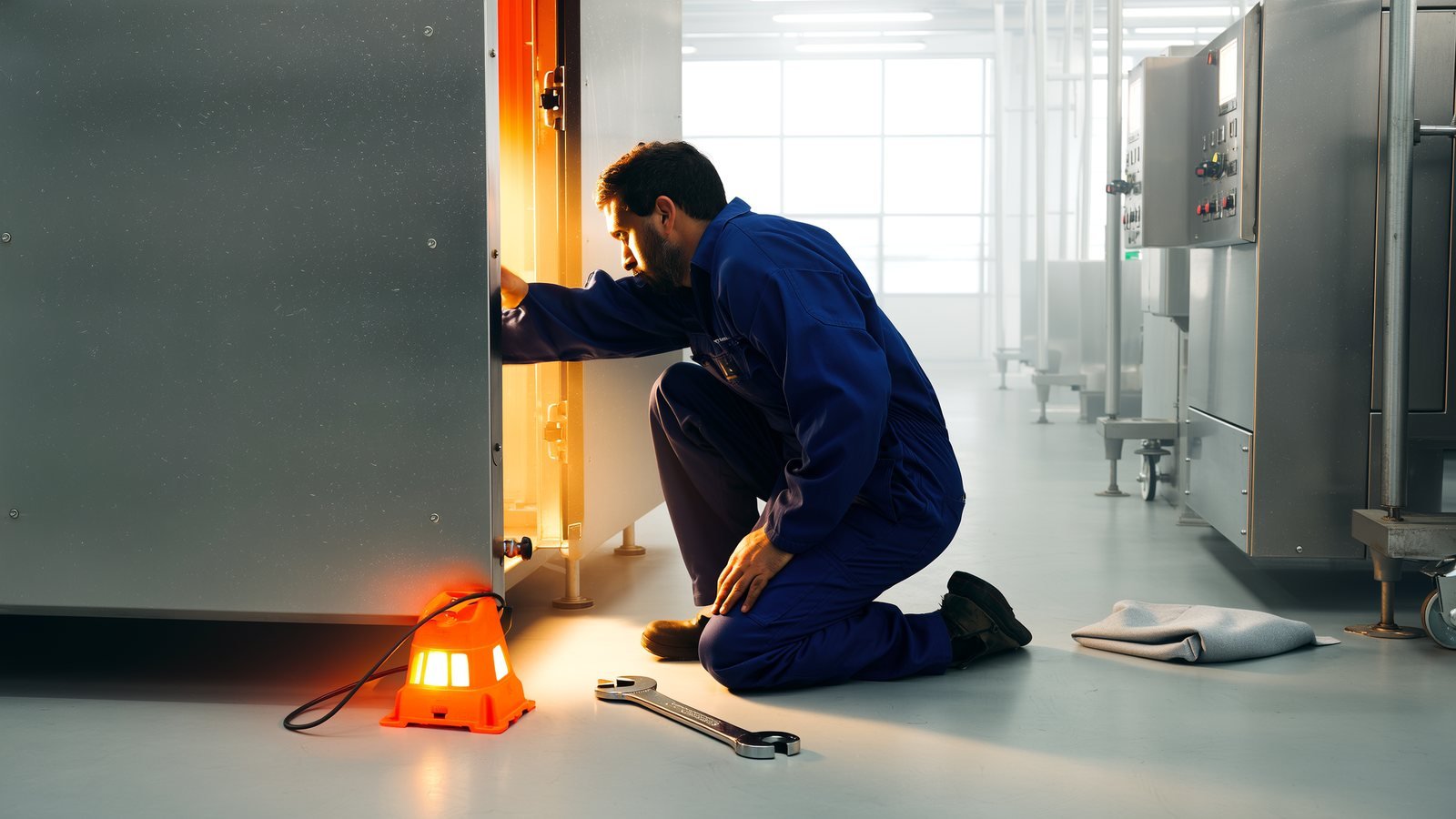
Pull your 30-day downtime log and look at the mechanical stops. They repeat. The same seal, the same bearing, the same photo-eye. And half the downtime usually isn't the fix — it's the wait for the part.
Build a kit for each of your top five repeat failures: every part the fix needs, bagged, labeled, on a shelf by the line. On a typical bottling or pouch line, that looks like this:
| Repeat failure | What to kit | Shelf cost | Typical wait without it |
|---|---|---|---|
| Filler seals and O-rings | Full seal set per head size, food-grade lube | $200-$800 | 3-10 days |
| Conveyor bearings and belts | Two bearing sets, one spare belt per width | $300-$1,200 | 2-7 days |
| Capper wear parts | Chuck inserts, clutch discs, spare springs | $150-$600 | 5-14 days |
| Pump internals | Rebuild kit per pump model on site | $400-$2,500 | 1-3 weeks |
| Sensors and photo-eyes | Two of every sensor that stops the line | $100-$500 | 2-5 days |
Total shelf investment: roughly $1,200 to $5,500. Against $2,000-5,000 per unplanned hour, a kit pays for itself the first time it turns a three-day wait into a 40-minute swap. And a fast swap is a practiced swap — stage the parts the way you stage change-parts, and the discipline transfers.
When Downtime Data Justifies New Iron
Two quarters of honest tracking also settles the capex argument. The rule of thumb: when one asset causes 30% or more of your unplanned hours, and twelve months of its repairs plus its downtime cost exceed a quarter of the replacement price, the new machine isn't a splurge. It's cheaper than keeping the old one.
That's the same math that makes automation for small food plants pencil out — you're not buying speed, you're buying hours back. And your downtime log turns the purchase from a gut call your banker questions into a one-page case your banker signs.
Recovered Hours Only Pay When They're Sold
One last piece of honesty. Cut downtime from 200 hours a year to 80 and you've recovered 120 hours of capacity. If those hours sit empty, you've saved the restart waste and not much else — the overhead runs either way. The plants that get paid twice for reliability do two things: they fill the recovered hours with new business, and they sell the reliability itself. "97% schedule attainment, and here's the log" wins brand audits against bigger plants that can't produce a number.
Filling those hours is a sales problem, not a maintenance one — the job an outbound engine like Feed The Line's co-packer sales program is built for. The sequence matters, though: track first, fix the five repeat failures, then sell the hours you got back.
Frequently asked questions
Q-01What is a good OEE for a small food manufacturing plant?
Measured honestly — with changeovers and CIP counted against availability — most $2-15M food plants land between 40% and 60% OEE. The 85% "world class" benchmark comes from single-SKU automotive lines, and almost no high-changeover food plant hits it. Your six-month trend matters far more than the benchmark.
Q-02How do I track downtime without CMMS software?
Hang a whiteboard at each line and log every stop over five minutes: time, duration, and reason, using ten reason codes or fewer. Tally hours by reason every Friday for 30 days. Four or five causes will account for 60-80% of your lost hours, and those become your fix list.
Q-03How much does unplanned downtime cost a food plant per hour?
For a $2-15M plant, count lost revenue per scheduled hour, idle labor, and restart waste — most land between $2,000 and $5,000 per unplanned hour. A plant losing 50 hours a quarter is leaking six figures a year. Run your own number: annual revenue divided by scheduled line-hours, plus crew cost, plus scrap.
Written by
Akash Garg
Director, DESENO Media Agency
Akash is Director at DESENO Media Agency, the studio behind Feed The Line. He writes about how food & beverage manufacturers turn plant capability into positioning, pipeline, and signed contracts.
DESENO ↗